
Living with missing or severely damaged teeth can affect how you eat, speak and interact with others. A removable denture may replace the visible teeth, but it does not always provide the stability that patients expect during everyday activities.
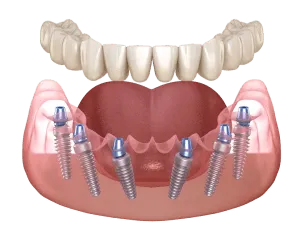
All-on-6 dental implants offer another possibility. Instead of replacing every missing tooth with an individual implant, six carefully positioned implants support a fixed restoration across an entire dental arch.
But who is suitable for this treatment? Can fixed teeth be placed immediately? What happens if there is not enough bone?
Understanding these questions is essential before making a decision.
At Radiance Dental Hospital in Tirana, every All-on-6 treatment is based on clinical examination, three-dimensional diagnostics and personalised surgical and prosthetic planning.
What does “All-on-6” actually mean?
The term All-on-6 describes a full-arch dental restoration supported by six implants.
The implants are placed at selected points within the upper or lower jaw. Once stable, they support a connected bridge that replaces the missing teeth across that arch.
The purpose of this approach is not simply to fill visible gaps. It aims to rebuild several functions at the same time:
- Biting and chewing
- Stability while speaking
- Support for the lips and facial tissues
- The proportions of the smile
- Confidence during daily activities
The bridge remains fixed to the implants. It is not removed by the patient at night, although professional removal may sometimes be required for maintenance.
Are you replacing teeth or rebuilding the entire bite?
This is one of the most important distinctions in full-arch treatment.
When many teeth are missing or badly damaged, the problem may involve more than appearance. The bite may have collapsed, the remaining teeth may have moved, and the distance between the upper and lower jaws may have changed.
An All-on-6 plan must therefore consider:
- The relationship between both jaws
- The available space for the new teeth
- The position of the jaw joints
- The strength of the chewing muscles
- The condition of any remaining teeth
- Facial appearance at rest and while smiling
A successful treatment is not based only on placing implants. It requires the reconstruction of a balanced and functional bite.
Who may benefit from an All-on-6 assessment?
An assessment may be appropriate if you:
- Have lost all teeth in one or both arches
- Have multiple loose or failing teeth
- Experience repeated dental infections
- Struggle to chew with a removable denture
- Use denture adhesive to improve stability
- Want to explore a fixed alternative
- Have undergone several unsuccessful dental treatments
However, having missing teeth does not automatically make someone suitable for six implants.
General health, bone availability, gum condition, smoking, diabetes and oral hygiene can all influence the treatment plan and prognosis.
What happens to the remaining natural teeth?
Remaining teeth should not be removed automatically simply because a full-arch implant solution is available.
During the initial examination, each tooth is assessed for:
- Mobility
- Bone support
- Root condition
- Decay or fracture
- Gum disease
- Previous treatment
- Long-term clinical prognosis
Teeth that can be predictably restored may still have value. Teeth with advanced damage or poor support may need to be removed before or during implant surgery.
The decision should be based on clinical evidence rather than convenience.
Why is a 3D scan essential?
A CBCT scan produces a three-dimensional view of the jaw. It allows the clinical team to examine areas that cannot be assessed accurately through photographs or a standard two-dimensional image alone.
The scan helps identify:
- Bone height and width
- The shape of the jaw
- The location of nerves
- The position of the maxillary sinuses
- Hidden infections or bone defects
- Potential sites for implant placement
At Radiance Dental Hospital, CBCT information can be combined with a digital scan of the mouth. This allows the implant positions to be planned in relation to the future bridge.
The key question is not only whether an implant fits inside the bone. It must also emerge in a position that supports the future restoration correctly.
Why can two patients receive different All-on-6 plans?
No two jaws have exactly the same anatomy.
One patient may have sufficient bone for six implants without additional procedures. Another may require bone regeneration or a different implant distribution. A third may be better suited to another full-arch technique.
Treatment plans can vary because of:
- Differences in bone volume
- Previous extractions
- Gum disease
- Sinus position
- Existing implants
- Bite pressure
- Bruxism
- Medical history
- The desired type of final restoration
This is why a treatment plan prepared for one patient should not be used as a standard for another.
Can fixed teeth be provided shortly after surgery?
In selected cases, a fixed provisional bridge may be placed within approximately 24 to 72 hours after implant surgery. This approach is commonly known as immediate loading.
Its suitability depends on the stability achieved by the implants and the clinical conditions identified during treatment.
Immediate loading may not be advisable when:
- Initial implant stability is insufficient
- Bone quality is poor
- Extensive grafting has been performed
- The bite cannot be controlled safely
- Medical or behavioural factors increase risk
Waiting can sometimes be the safer clinical decision. Receiving teeth quickly should never be prioritised over implant healing.
Why are the first teeth provisional?
The provisional bridge serves a different purpose from the final restoration.
It allows the implants and surrounding tissues to heal while providing temporary function and appearance. It also gives the clinical team an opportunity to test the design.
During this phase, the team can assess:
- Speech and pronunciation
- Lip support
- Tooth length and position
- Comfort while closing the mouth
- Distribution of the bite
- Access for daily cleaning
The information collected during the provisional phase can guide the design of the final bridge.
What can you eat during the healing period?
A fixed provisional bridge may feel stable, but the implants are still integrating with the bone.
Patients are generally advised to follow a softer diet during the initial healing period. Very hard, crunchy or sticky foods may place excessive pressure on the implants.
Food should be cut into smaller pieces, and chewing forces should be kept controlled according to the clinical instructions provided.
Ignoring dietary guidance can place unnecessary stress on the provisional restoration and the healing implants.
How long does implant integration take?
Osseointegration is the biological process through which bone establishes stable contact with the implant surface. It usually requires several months, although healing time differs between patients.
Factors that can influence this stage include:
- Bone quality
- Implant location
- Smoking
- Diabetes control
- Oral hygiene
- Pressure on the provisional bridge
- Individual healing response
Follow-up appointments allow the team to monitor the tissues, implant stability, bite and condition of the provisional restoration.
What happens when the implants have healed?
Once implant integration is confirmed, the definitive prosthetic phase can begin.
New digital or physical records are taken to capture the position of the implants and the condition of the healed tissues. The final restoration is then designed according to functional and aesthetic requirements.
The process may involve evaluating:
- Tooth shape and proportions
- Smile line
- Gum appearance
- Shade selection
- Facial profile
- Bite contacts
- Cleaning access
The goal is not to create the same smile for every patient. A natural-looking restoration should reflect the person’s facial structure and individual characteristics.
Is All-on-6 always made from zirconia?
No. All-on-6 refers to the implant configuration, not to one mandatory prosthetic material.
Zirconia may be considered for some definitive restorations because of its aesthetic and mechanical properties. However, material selection depends on the available space, bite, design of the supporting structure and clinical needs.
The strongest or most expensive material is not automatically the most suitable. The restoration must work as part of the entire treatment plan.
All-on-6 or individual implants: what is the difference?
Individual implants may be appropriate when only a few teeth are missing and neighbouring teeth remain healthy.
All-on-6 is designed for a complete or nearly complete arch. It uses six implants to support a connected restoration rather than placing one implant for every missing tooth.
The right choice depends on how many teeth can be preserved and whether they have a reliable long-term prognosis.
Is All-on-6 better than All-on-4?
All-on-6 provides two additional support points, which may be useful for load distribution in suitable cases.
That does not mean it is always better.
All-on-4 may be selected when anatomy, bone availability or the planned restoration favours four strategically positioned implants. All-on-6 may be preferred when adequate bone and prosthetic space allow the use of six implants.
A higher number of implants cannot correct poor positioning or an unsuitable prosthetic design. Diagnosis and planning remain more important than the name of the technique.
Can All-on-6 be performed if bone has been lost?
Bone loss is common after long-term tooth loss, gum disease or the use of removable dentures.
Depending on the location and severity of the deficiency, possible options may include:
- Bone grafting
- Guided bone regeneration
- Sinus elevation
- Alternative implant positions
- Different full-arch implant techniques
Some patients may not need grafting, while others require an additional surgical stage. A CBCT assessment is necessary to determine which approach may be considered.
How do you clean fixed All-on-6 teeth?
Although the bridge is fixed, plaque and food debris can still collect underneath it and around the implants.
Daily care may include:
- A soft manual or electric toothbrush
- Interdental brushes
- Implant bridge floss
- A water flosser
- Professionally recommended cleaning products
Professional hygiene appointments are also important. During these visits, the clinical team can examine the gums, bridge, implant components and bite.
Bleeding, swelling, unpleasant taste or persistent bad breath should be assessed rather than ignored.
How long can All-on-6 implants last?
There is no single lifespan that applies to every patient.
Implant survival and restoration maintenance depend on several factors:
- Oral hygiene
- Smoking habits
- Gum health
- Diabetes control
- Teeth grinding
- Bite pressure
- Regular professional reviews
- Quality of surgical and prosthetic planning
It is also important to distinguish between the implants and the bridge. Even when implants remain stable, prosthetic screws, surfaces or other components may require maintenance over time.
What questions should you ask your implant team?
Before beginning treatment, ask:
- Can any of my natural teeth be preserved?
- What does my CBCT scan show?
- Why are six implants recommended in my case?
- Will I need bone grafting?
- Am I suitable for immediate loading?
- What type of provisional bridge will I receive?
- What material is planned for the final restoration?
- How will I clean underneath the bridge?
- What follow-up care will I need?
- What are the limitations and specific risks in my case?
A responsible treatment plan should explain both the possibilities and the limitations.
All-on-6 treatment at Radiance Dental Hospital
Radiance Dental Hospital brings together the main stages of full-arch rehabilitation within one dental facility in Tirana.
The treatment pathway may include:
- CBCT 3D diagnostics
- Digital intraoral scanning
- Implant planning
- Oral and maxillofacial surgery
- Implant dentistry
- Prosthetic dentistry
- Digital dental laboratory
- Post-treatment monitoring
- Assistance for international patients
Coordination between these areas helps the team plan the surgical and prosthetic stages as one complete treatment rather than as separate procedures.
A decision built on diagnosis, not assumptions
All-on-6 dental implants may offer a fixed solution for patients with extensive tooth loss, but the treatment must be justified by the clinical findings.
The number of implants is only one part of the decision. Bone condition, implant position, bite design, hygiene access and long-term maintenance are equally important.
If you are considering fixed full-arch teeth, the first step is a detailed assessment to understand which options are suitable for your individual case.
Contact Radiance Dental Hospital in Tirana for more information about All-on-6 dental implants in Albania and the diagnostic process required before treatment.


