
Missing teeth can affect much more than the appearance of your smile. They may influence chewing, speech, facial balance and overall oral comfort. Dental implants provide a fixed solution for replacing one or more missing teeth and can also be used for complete full-arch rehabilitation.
At Radiance Dental Hospital in Tirana, dental implant treatment begins with a detailed clinical assessment, 3D diagnostics and digital planning. Each treatment plan is developed according to the patient’s individual anatomy, bone structure, oral health and functional needs.
What Are Dental Implants?
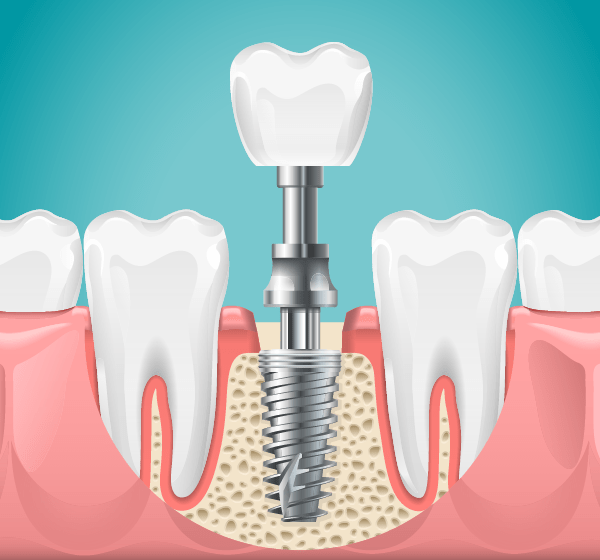
A dental implant is a small structure placed into the jawbone to replace the root of a missing tooth.
Once the implant has integrated with the bone, it can support a dental crown, bridge or a complete fixed prosthesis.
Dental implants can be used to replace:
- A single missing tooth
- Several missing teeth
- Multiple consecutive teeth
- A complete upper or lower arch
- Both dental arches in full-mouth rehabilitation cases
The main goal is to restore function, stability and a natural-looking smile.
Who Can Consider Dental Implant Treatment?
Dental implants may be suitable for patients who have lost teeth because of advanced decay, periodontal disease, trauma, fractures or previous extractions.
They can also be considered by patients who currently wear removable dentures and would like to explore a fixed alternative.
However, dental implant treatment is not identical for every patient.
Before treatment begins, it is important to assess:
- Bone volume and quality
- Gum health
- Remaining teeth
- Bite and jaw relationship
- General oral condition
- Individual functional requirements
A complete diagnosis helps determine which implant treatment is most appropriate.
3D Diagnostics for Dental Implants
Accurate diagnosis is one of the most important stages of implant dentistry.
Modern 3D imaging allows the medical team to evaluate the patient’s jawbone and important anatomical structures before implant placement.
At Radiance Dental Hospital, diagnostic evaluation may include CBCT Cone Beam imaging and digital intraoral scanning.
These technologies help assess:
- Available bone height and width
- Bone structure
- Implant position
- Nearby anatomical structures
- Relationship between implants and the future teeth
- Possible need for additional surgical procedures
Detailed diagnostics allow the treatment to be planned before the surgical phase begins.
Digital Implant Planning
Digital planning plays an important role in modern implant dentistry.
Using 3D images and digital scans, the clinical team can study the patient’s anatomy and plan the position of the implants according to the intended prosthetic result.
Implant placement should not be considered separately from the final teeth.
The surgical and prosthetic stages must work together to create a functional and balanced rehabilitation.
This is why implant dentistry often requires coordination between oral surgery, prosthodontics, radiology and digital dentistry.
Single Dental Implant
When only one tooth is missing, a single dental implant may be used to support an individual dental crown.
This approach can allow the missing tooth to be replaced without using the neighbouring teeth as support for a traditional bridge, when clinical conditions permit.
The final crown is designed according to the shape, size, position and appearance of the surrounding teeth.
Replacing Several Missing Teeth
If several teeth are missing next to each other, it is not always necessary to place one implant for every missing tooth.
In certain cases, multiple implants can support a fixed dental bridge.
The number and position of implants depend on several factors, including bone availability, bite forces, anatomical conditions and the design of the final prosthesis.
Full-Arch Dental Implants
Patients who have lost most or all of their teeth may be candidates for a complete fixed rehabilitation supported by dental implants.
Full-arch implant dentistry is designed to restore an entire dental arch using a planned number of implants.
Depending on the patient’s clinical situation, different treatment concepts can be considered, including All-on-4 and All-on-6.
All-on-4 Dental Implants
All-on-4 is a full-arch rehabilitation concept in which four dental implants are used to support a complete fixed prosthesis.
It can be considered for patients who have lost all their teeth or whose remaining teeth cannot be predictably maintained.
The suitability of All-on-4 depends on bone anatomy, implant stability, oral health and the overall treatment plan.
For this reason, a detailed diagnostic evaluation is required before deciding whether this approach is appropriate.
All-on-6 Dental Implants
All-on-6 generally uses six implants to support a complete fixed dental arch.
In appropriate cases, the additional implants can provide another option for distributing chewing forces across the rehabilitation.
However, choosing between All-on-4 and All-on-6 should not depend only on the number of implants.
Bone structure, anatomy, bite, prosthetic design and individual clinical conditions should all be considered.
What If There Is Not Enough Bone?
Insufficient bone does not automatically mean dental implants are impossible.
When bone volume is reduced, additional procedures may sometimes be considered to create better conditions for implant placement.
Depending on the clinical case, these procedures can include:
- Bone grafting
- Guided bone regeneration
- Bone augmentation
- Sinus lift procedures
Not every patient requires bone regeneration.
The need for these treatments can only be determined after clinical and radiological assessment.
Bone Grafting and Guided Bone Regeneration
Bone can decrease after tooth loss, periodontal disease or previous infections.
When there is not enough bone to provide adequate support for an implant, a bone regeneration procedure may be considered.
Guided bone regeneration and bone grafting are techniques used in selected cases to increase the available bone volume.
The type of procedure depends on the location and extent of the bone deficiency.
Sinus Lift for Dental Implants
In the posterior area of the upper jaw, the maxillary sinus can limit the amount of bone available for implant placement.
A sinus lift may be considered when additional bone height is required in this area.
There are different approaches to sinus augmentation, and the appropriate technique depends on the patient’s anatomy and existing bone volume.
Immediate Loading Dental Implants
In selected cases, it may be possible to place a fixed temporary restoration shortly after implant surgery.
This treatment approach is known as immediate loading.
However, immediate loading is not suitable for every patient.
Several factors must be evaluated first, including:
- Primary implant stability
- Bone quality
- Number and position of implants
- Bite forces
- Type of prosthetic rehabilitation
The decision should always be based on clinical conditions rather than speed alone.
From Implant Surgery to the Final Teeth
Dental implant rehabilitation can involve several stages.
The first stage includes consultation, diagnosis, digital scans and treatment planning.
The surgical stage involves the placement of the implants into the jawbone.
Depending on the case, temporary teeth may be provided during the healing period.
After the implants have reached the appropriate level of integration, the definitive prosthetic phase can begin.
The final restoration is planned according to:
- Function
- Bite
- Facial proportions
- Speech
- Tooth shape
- Smile aesthetics
- Gum relationship
Zirconia Teeth on Dental Implants
Zirconia is widely used in modern restorative dentistry for crowns, bridges and implant-supported rehabilitations.
Its mechanical and aesthetic characteristics make it suitable for different types of dental restorations.
In implant dentistry, zirconia can be considered for individual crowns as well as more extensive prosthetic solutions.
The choice of material should always be based on the patient’s functional and aesthetic requirements.
How Long Do Dental Implants Last?
There is no fixed lifespan that applies to every dental implant.
Long-term implant stability depends on many factors, including treatment planning, bone health, gum health, oral hygiene and regular professional maintenance.
Lifestyle and individual habits can also influence long-term results.
For this reason, dental implants should not be considered maintenance-free.
Regular dental check-ups and professional cleaning remain important after treatment.
Caring for Dental Implants
Although dental implants cannot develop cavities like natural teeth, the tissues around them still require daily care.
Plaque accumulation can cause inflammation around implants and may affect the surrounding gums and bone.
Good oral hygiene should therefore include proper cleaning around the implant-supported teeth and regular professional examinations.
Long-term maintenance is an important part of successful implant treatment.
Gum Health Around Dental Implants
Healthy gums play an important role in the stability and appearance of implant-supported teeth.
Before implant treatment, existing periodontal problems should be carefully evaluated.
After treatment, maintaining healthy tissues around the implants helps protect the rehabilitation over time.
Professional hygiene and regular monitoring can help detect potential problems at an early stage.
A Multidisciplinary Approach to Implant Dentistry
Complex implant treatments often involve more than one dental specialty.
Oral surgeons, implantologists, prosthodontists, radiology specialists and dental technicians may all contribute to the treatment process.
At Radiance Dental Hospital, the different stages of implant treatment can be coordinated within the same dental hospital.
This allows diagnosis, surgical treatment and prosthetic rehabilitation to be planned as part of one complete clinical pathway.
Why Every Implant Case Is Different
Two patients who are missing the same number of teeth may require completely different treatments.
Bone anatomy, gum condition, jaw position, remaining teeth and bite forces can vary significantly from one person to another.
For this reason, choosing a treatment simply because it uses four, six or another number of implants can be misleading.
The correct treatment should be based on individual diagnosis and prosthetic planning.
Dental Implants in Tirana at Radiance Dental Hospital
Radiance Dental Hospital provides dental implant treatments in Tirana using modern diagnostic and digital planning technologies.
Depending on the individual case, the treatment pathway may include 3D CBCT diagnostics, digital scanning, implant surgery, bone regeneration procedures and implant-supported prosthetic rehabilitation.
Each case is evaluated individually before treatment begins.
The objective is to develop a dental solution that considers function, stability, aesthetics and the patient’s specific anatomical conditions.
A Fixed Smile Starts With the Right Diagnosis
Dental implants can provide an effective solution for replacing missing teeth, but successful treatment begins before implant placement.
A detailed examination and accurate diagnosis help determine whether dental implants are suitable and which type of rehabilitation should be considered.
The first step is understanding the patient’s individual clinical situation and creating a treatment plan based on real anatomical and functional needs.


